
EXECUTIVE SUMMARY
In 2026, European sustainable finance will shift from building disclosure frameworks to managing hard financial risk. For EU banks, the critical development is not another reporting template, but the operationalization of Prudential Transition Plans as the central engine of solvency and risk management.
While early ESG frameworks focused on transparency (the "outside-in" view), the removal of the mandatory corporate transition plan requirement from the final CSDDD deal in late 2025 has created a "Regulatory Vacuum." Banks will find themselves no longer be able to rely on statutory obligations for their clients to produce transition plans, instead, supervisors now expect banks to act as the de facto enforcers, demanding credible plans as a condition of access to capital.
1. How Prudential Transition Plans work in 2026
Under CRD VI and the EBA ESG risk guidelines (applicable Jan 2026), a prudential transition plan will be served as a solvency preservation tool, not a sustainability brochure. It must demonstrate that the bank can survive the economic restructuring of the next decade. In practice, a credible plan must:
Move from "Slide Deck" to "Credit File"
The era of high-level heatmaps is over. Supervisors now test credit file integration on:
Pricing & Covenants: Does the transition risk assessment appear in the final credit memo? Best practice in 2026 involves "Ratchet Clauses" or margin grids where interest rates rise if a client misses decarbonization milestones.
Underwriting: If a client has high transition risk, does the plan mandate a lower Loan-to-Value (LTV) ratio or shorter tenor? If the file shows a "High Risk" flag but the loan was approved with standard terms, the plan is considered ineffective.
Adopt "Dynamic" Balance Sheet Modelling
Standard stress testing often assumes a static balance sheet (constant portfolio). However, a Prudential Transition Plan must be dynamic:
It must model the intended portfolio composition in 2030 and 2035.
It must prove that the bank’s strategy to exit high-carbon sectors is financially feasible (i.e., replacing lost "brown" revenue with "green" revenue) and not just wishful thinking.
Embed in ILAAP (Liquidity), not just ICAAP
Banks often overlook the liquidity dimension. A sound plan assesses "Collateral Liquidity":
Will "brown" assets (e.g., energy-inefficient real estate) remain eligible as High Quality Liquid Assets (HQLA) or ECB collateral in a severe transition scenario?
Does the bank face "Reputational Liquidity Risk" (green deposit flight) if it fails to meet its targets?
Governance: From "Approval" to "Effective Challenge"
Supervisors are no longer satisfied with Board approval. They look for evidence of "Effective Challenge" in meeting minutes:
Did the Risk Committee question the feasibility of the "Net Zero" targets?
Did they challenge the data quality of Scope 3 emissions?
Pillar 2 consequence: failures here trigger Pillar 2 Requirements (P2R) (add-ons for governance weakness), whereas quantitative risks identified in stress tests drive Pillar 2 Guidance (P2G).
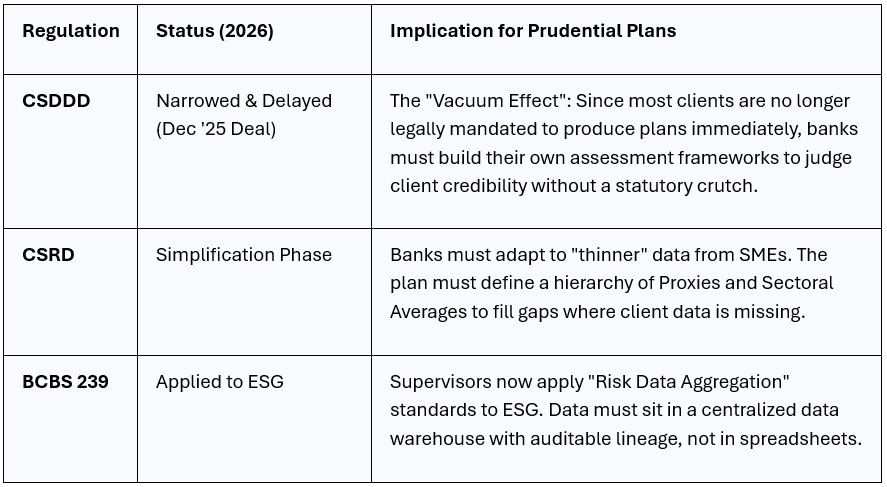
2. Interaction with the rulebook: The "Burden Shift"
The regulatory landscape has evolved to place the burden of proof squarely on the bank.
3. Where most plans fall short
Supervisory reviews in 2025 highlighted three critical failures that banks must correct:
The "Green Halo" & Conduct Risk
Banks often assume that funding a "transitioning" oil major is safe if the loan is labelled "green."
The Risk: If the client fails to transition, the bank faces Litigation & Conduct Risk for mis-selling "transition finance" to investors.
The Fix: The plan must include a legal risk assessment of greenwashing liability.
Linear Risk Assumptions
Credit models often assume risk rises linearly. Real-world transition risk is non-linear and driven by "Cliff Effects":
Collateral Cliff: An energy-inefficient building may lose 30% of its value overnight due to a new regulation (e.g., ban on renting), long before the borrower defaults.
The Fix: Models must incorporate LGD (Loss Given Default) shocks that correlate with PD (Probability of Default).
Operational Disconnect
The Risk: The Sustainability team writes the plan but the Deal team ignores it.
The Fix: The plan is only credible if it is linked to Remuneration. Deal teams must have KPIs linked to the risk profile of the new origination, not just volume.
4. Executive Takeaways for 2026
For the Board and CRO, readiness for the 2026 SREP cycle boils down to five questions:
Is our Plan "Decision-Useful"? Can we show the supervisor a list of deals we declined or repriced specifically because of the transition plan?
Is our Data BCBS 239 Compliant? Is our ESG data fully integrated into our IT architecture with data lineage, or is it still manual?
Do we have "teeth"? Are we using covenants and ratchet clauses to enforce client transition, or just relying on "engagement" meetings?
Is Liquidity covered? Have we stress-tested our collateral pool for "brown" discounts?
Are we protected against Litigation? Does our plan mitigate the risk of being sued for greenwashing if our "transition" clients fail to decarbonize?
If the answer to any of these is "No," the bank remains exposed to both Pillar 2 capital add-ons and significant reputational liability.