

EXECUTIVE SUMMARY
The EU Omnibus Simplification Package introduces significant changes to sustainability reporting, including extended deadlines and scope reductions for approximately 80% of companies originally in scope
While smaller enterprises gain relief, Wave 1 companies must still comply with original timelines and comprehensive reporting requirements, creating a two-speed sustainability landscape
Companies face a strategic choice: scale back sustainability investments or continue building capabilities that deliver business value regardless of regulatory outcomes
Five key actions create competitive advantage: materiality assessment, effective governance, leadership development, stakeholder engagement, and robust data systems
Organizations implementing these fundamental capabilities now will outperform competitors while maintaining flexibility to adapt as regulations evolve
The most successful approach integrates these actions into a cohesive strategy rather than treating them as isolated compliance initiatives
The most valuable sustainability investments enhance business performance regardless of where reporting requirements ultimately land
What Happened: The Evolving Regulatory Landscape
In February 2025, the European Commission adopted a draft "Omnibus Simplification Package" to streamline key sustainability regulations, including the Corporate Sustainability Reporting Directive (CSRD), Corporate Sustainability Due Diligence Directive (CS3D), and EU Taxonomy Regulation. The package aims to reduce regulatory burdens while preserving core sustainability obligations.
Approval and Timeline Adjustments
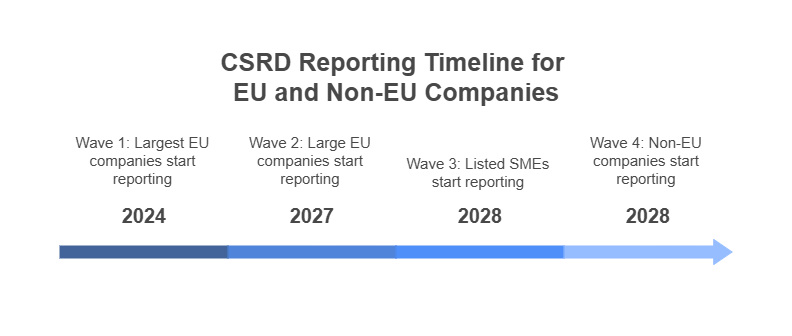
On April 3, 2025, the European Parliament approved the package's "stop the clock" mechanism, which delays reporting deadlines by two years for specific company categories:
- The 2025 stop-the-clock amendment postponed reporting for later CSRD waves. The final 2026 Omnibus amendment then changed the scope itself. Determine the reporting obligation using the revised company/group thresholds, the financial year and national implementation, rather than assuming every company in an old wave will still report. Listed SMEs are removed from mandatory CSRD scope. Transitional relief can also affect former Wave 1 companies.
CSRD Scope Reduction
The package significantly narrows the scope of the CSRD by raising eligibility thresholds:
- Under the final 2026 amendment, the principal EU-company test requires both more than 1,000 employees and more than €450 million net turnover, with separate group and third-country provisions. Confirm the exact entity, group and transitional conditions before treating a company as in or out of scope.
CS3D Simplifications
The CS3D (Corporate Sustainability Due Diligence Directive) sees targeted adjustments:
- Due diligence covers risk-based scoping across the relevant chain of activities, not direct partners only. Periodic effectiveness assessments must occur at least every five years and also when specified changes or concerns require them. The amended CSDDD applies to in-scope companies from 26 July 2029, following the 26 July 2028 transposition deadline.
EU Taxonomy Adjustments
Taxonomy corporate reporting is linked to the sustainability-reporting duties under the Accounting Directive through Article 8 of Regulation (EU) 2020/852. It is not confined to companies in CSDDD scope. Assess the applicable reporting year, CSRD scope and Taxonomy disclosure rules together.
Unchanged Core Obligations
Despite simplifications, key requirements remain intact:
Double Materiality Assessment: Companies must evaluate both how sustainability issues impact financial performance and how their operations affect society and the environment.
- Recheck third-country reporting conditions and transitional relief rather than assuming they are unchanged. Some former Wave 1 companies can be exempted for financial years 2025–2026 under national implementation. Limited assurance remains the CSRD requirement. The former mandatory progression toward reasonable assurance was removed.
Additional Changes
Sector-Specific Standards: The Commission’s power to adopt sector-specific standards is abolished.
Regulatory Burden Reduction: The package prioritizes proportionality, focusing obligations on larger firms while easing requirements for SMEs and non-EU entities below thresholds.
This revised package balances sustainability goals with practical implementation, ensuring that Wave 1 companies lead compliance efforts, Wave 2 and 3 companies gain breathing room, and Wave 4 non-EU firms adhere to consistent timelines.
The No-Regrets Playbook: Five Actions That Deliver Value No Matter What
Regardless of how the Omnibus Package evolves, these five strategic actions deliver measurable business value, positioning organizations for long-term success while maintaining regulatory flexibility.
1. Conduct a Double Materiality Assessment
Map which sustainability issues genuinely matter for your business success and stakeholder relationships through a rigorous double materiality assessment: an approach that examines both how sustainability issues impact your financial performance and how your company impacts society and the environment.
Double materiality eliminates wasted resources by focusing sustainability investments where they deliver tangible results. This approach allows companies to reduce unnecessary tracking metrics and concentrate efforts on initiatives that meaningfully impact business performance and stakeholder concerns.
Different industries prioritize material issues based on their specific business models and impacts. Financial services typically focus on portfolio climate risk and sustainable financing. Manufacturing emphasizes resource efficiency and product lifecycle impacts. Consumer goods companies often prioritize sustainable sourcing, packaging, and product transparency.
2. Build Cross-Functional Governance That Actually Works
Effective governance transforms sustainability from a compliance exercise into strategic advantage. Organizations with integrated governance structures demonstrate higher implementation rates for sustainability initiatives and identify more cost-saving opportunities. Having this governance in place also better prepares companies for ongoing and upcoming sustainability-related topics, ensuring readiness for emerging trends and regulatory developments. With the Omnibus Package's "stop the clock" mechanism providing additional implementation time, there is no better moment to establish robust governance structures. Organizations that strategically utilize this extension to build comprehensive oversight frameworks will gain significant competitive advantage. Key elements include cross-departmental representation, clear executive accountability, and integration of sustainability metrics into performance evaluation.
3. Upskill Leadership on Practical Sustainability Knowledge
Informed leadership makes better strategic decisions and provides the oversight necessary for sustainability initiatives to succeed. Organizations with sustainability-knowledgeable leadership demonstrate higher resource efficiency and better identification of market opportunities. Leadership development should focus on practical knowledge of material sustainability issues, risk assessment methodologies, and emerging regulatory frameworks.
4. Engage Stakeholders Systematically and Proactively
Proactive stakeholder engagement identifies emerging risks well before they become problems, creating strategic opportunities while preventing costly reputational damage. Companies with mature stakeholder engagement processes demonstrate fewer sustainability-related controversies and faster resolution when issues arise. Effective engagement should include formal feedback mechanisms, transparent communication channels, and integration of stakeholder insights into strategic planning.
5. Implement Adaptable Data Systems
Robust data infrastructure is the foundation of effective sustainability management. Organizations with mature sustainability data systems spend less time on reporting activities and respond faster to new disclosure requirements than those relying on ad-hoc approaches. Effective systems prioritize material metrics, ensure interoperability with existing business systems, and maintain flexibility to adapt to evolving regulatory frameworks.
Why These Actions Matter: Creating Strategic Advantage
These five actions create tangible business value regardless of where the Omnibus regulatory process ultimately lands.
Business Risk Reduction
Implementing these fundamental capabilities helps organizations identify and manage risks more effectively. Double materiality assessment provides early visibility into emerging issues that could impact business continuity. Proper governance ensures sustainability risks are evaluated with the same rigor as financial ones. Upskilled leadership makes better risk mitigation decisions. Proactive stakeholder engagement identifies concerns before they become crises. Solid data infrastructure provides the foundation for reliable risk monitoring.
Operational Efficiency
These actions drive operational improvements beyond compliance. Organizations focusing on material issues typically find significant resource efficiency opportunities during assessment processes. Effective governance streamlines decision making by clarifying accountabilities. Knowledgeable leadership directs resources toward highest-value sustainability initiatives. Stakeholder insights often reveal efficiency opportunities not visible internally. Robust data systems reduce redundant data collection efforts and reporting costs.
Market Differentiation
Forward-thinking organizations gain competitive advantage through these capabilities. Companies with clear materiality focus communicate their sustainability value proposition more effectively to customers and investors. Organizations with authentic governance demonstrate commitment beyond surface-level sustainability claims. Leadership teams knowledgeable about sustainability trends identify market opportunities competitors miss. Effective stakeholder engagement builds reputation and trust advantages. Comprehensive data systems enable rapid response to changing market demands for sustainability information.
Future-Proofing the Business
Despite regulatory uncertainty, these fundamental capabilities maintain their value as sustainability expectations continue evolving. The core principles of materiality, governance, leadership competency, stakeholder engagement, and data management remain essential regardless of specific reporting requirements. Organizations implementing these practices now build flexibility to adapt to whichever regulatory direction ultimately emerges, while those delaying action risk falling behind.
What's Next?
The Omnibus I amendment is now adopted as Directive (EU) 2026/470. The Commission also adopted revised ESRS on 3 July 2026, subsequently published as Regulation (EU) 2026/1563. It enters into force on 10 November 2026, applies to financial years beginning on or after 1 January 2027 and provides transitional choices for 2026. Implementation planning should use the final texts and national transposition, while the strategic capability-building actions above remain management recommendations.
Market Expectations Beyond Regulation
Despite regulatory simplification, market expectations for meaningful sustainability performance will likely continue to strengthen. Investors, customers, and talent increasingly evaluate companies on sustainability criteria even in the absence of regulatory requirements. Organizations focusing solely on compliance minimums may find themselves at a competitive disadvantage in capital markets, customer relationships, and talent acquisition.
Action Points
Conduct a comprehensive capability assessment to identify gaps in sustainability management systems and prioritize strategic actions
Develop a tiered implementation roadmap with immediate 90-day actions and longer-term initiatives
Establish clear executive accountability with specific responsibilities for each strategic action
Create a cross-functional working group to integrate sustainability capabilities into core operations
Engage external expertise where needed while building internal capacity
Allocate capital strategically to ensure investments deliver both compliance readiness and business value
Communicate your approach to stakeholders, emphasizing long-term value creation beyond compliance